China is a major sourcing base for carbon fiber sheets, but “top manufacturer” depends on the job. A supplier suited to lightweight equipment panels may not fit a precision-machined part. Buyers need evidence beyond polished photos and broad claims.
MarketsandMarkets’ Carbon Fiber Market report estimated the global market at USD 5.5 billion in 2023 and projected USD 8.9 billion by 2028. That forecast signals expanding demand, not proof that every supplier offers consistent quality. Market definitions also vary between reports. A useful signal, not a verdict.
When comparing Chinese manufacturers, look closely at fiber grade, resin system, weave, sheet thickness, dimensional tolerances, and surface finish. Ask for current technical data sheets and inspection records. For a real check, compare a sample’s cut edges and thickness readings against its stated specifications. Still, one sample is not a factory. Production consistency matters. So do lead times, packaging, and clear answers about custom sizes.
This guide examines how to assess China-based carbon fiber sheets manufacturers and suppliers, rather than naming a winner without context. The strongest choice should match the application and provide verifiable documentation. If a supplier’s claims are difficult to confirm, treat that as a reason to ask more questions—not as a minor detail.
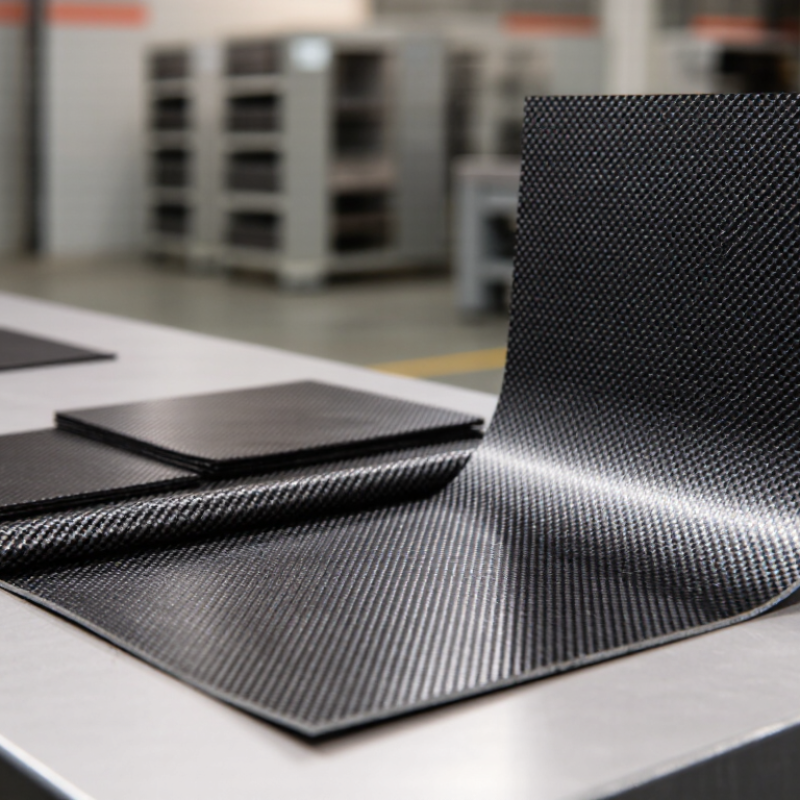
Carbon fiber sheets are flat composite panels made from fine carbon filaments held together by a polymer resin. The fibers carry much of the load, while the resin binds them and helps protect their structure. A sheet may use woven fibers, which form a visible grid, or aligned fibers designed for strength in particular directions. Look closely, and the surface may show subtle ridges or a glossy resin finish. Not every sheet performs the same way.
Manufacturing usually begins with carbon-fiber fabric or pre-impregnated material, often called prepreg. Workers cut the layers to size and arrange them in a mold, changing fiber direction to suit the intended use. The stack is then compacted and cured with controlled heat and pressure. This process helps limit trapped air and gives the panel its shape. Small changes matter. Fiber alignment, resin content, cure conditions, and layer count can all affect stiffness, weight, and surface quality. A smooth panel is not automatically a stronger one. In practical selection, check the stated thickness, layup, and test data rather than relying on appearance alone. Some product details remain difficult to compare when suppliers use different testing methods.
Carbon fiber sheets pair carbon filaments with a resin matrix, creating flat panels with high stiffness for their weight. Typical carbon-fiber-reinforced laminates have densities around 1.5–1.6 g/cm³, though resin and layup change the figure (ASM Handbook, Composites). Their behavior is directional. A unidirectional sheet handles loads best along its fibers; cross-ply layers improve strength in several directions. Not in every direction. This detail matters when designers choose sheet orientation for brackets, vehicle panels, sporting equipment, or lightweight equipment housings.
The U.S. Department of Energy’s Vehicle Technologies Office reports that reducing vehicle weight by 10% can improve fuel economy by roughly 6–8%. That’s a vehicle-level estimate, not a guaranteed result from replacing one panel. Carbon sheets are also easy to cut and bond, but drilled edges need care. Impact damage can be hard to see. There is a catch: carbon fiber conducts electricity, so contact with metals such as aluminum may require electrical isolation to reduce corrosion risk. In practical use, the right choice depends on load direction, surface finish, thickness, and inspection needs—not weight alone.
China’s Carbon Fiber Sheet Manufacturing and Supply Landscape
China’s carbon fiber sheet supply base includes composite material producers, sheet fabricators, and machining workshops. Their capabilities differ. Some make panels from prepreg and cure them under controlled heat and pressure. Others focus on cutting, drilling, or finishing sheets made elsewhere. For buyers, that distinction matters when comparing lead times and production control.
A useful specification states thickness, dimensions, fiber orientation, resin type, surface finish, and flatness requirements. Ask for a current technical data sheet and sample measurements. Inspect cut edges and panel surfaces for visible voids, waviness, or inconsistent finish. Small defects can affect assembly, even when a sheet looks sound at first glance. Details matter.
Supply options range from standard panels to made-to-order sizes, but custom work may require extra setup time. Request information about material traceability, inspection methods, and batch-to-batch consistency. These checks are not a guarantee. Quality can vary between suppliers, and published figures may not reflect every production run. A sample review and clear acceptance criteria help reduce uncertainty before a larger order. Consistency takes work.
Representative nominal thickness options for commercially supplied carbon fiber sheets
Commercial sheets are available in a range of nominal thicknesses, from thin panels for lightweight covers to thicker sections for more rigid applications. Exact sizes and tolerances vary by product and supplier.
China Top Carbon Fiber Sheets Manufacturer and Supplier?
A reliable Chinese supplier should show more than a smooth, glossy sheet. Ask for the fiber grade, resin system, layup direction, thickness tolerance, and intended service conditions. These details affect stiffness, weight, and how the sheet performs under load. Details matter.
Check recent inspection records and request a sample from a normal production run, not only a hand-picked piece. Measure thickness at several points with a calibrated gauge, and look for waviness, chipped edges, pinholes, or uneven finish. For critical uses, arrange suitable mechanical testing and confirm the method, sample size, and results. A certificate is useful, but it does not replace clear test data.
Evaluate production consistency, batch traceability, packaging, and the supplier’s ability to answer technical questions in writing. A quality management certificate can indicate organized processes, but it cannot prove that every sheet meets your specification. Samples can mislead. Compare multiple batches when possible, and record acceptance limits before placing a larger order. I would also check how the supplier handles a failed inspection; this step is easy to overlook, and a confident sales reply is not the same as a corrective-action record.
Selecting a carbon fiber sheet manufacturer in China requires more than comparing prices. Start with the sheet’s intended use, required thickness, surface finish, and expected load. Ask how the manufacturer controls fiber direction and resin content, since both affect strength and consistency. Request drawings, material specifications, and recent inspection records. Check whether reported tolerances match your application, not just the supplier’s standard capability. A low quote can omit machining, protective packaging, or testing.
Tips: Request a sample from the same production process planned for your order. Measure its thickness at several points, inspect the edges for delamination, and check the surface under good lighting. Ask for batch identification and traceability records. Verify that any certificates apply to the specific material and facility. A polished catalog is not proof of stable production. It is easy to overlook packaging; sheets can arrive scratched or warped if they are poorly supported.
Discuss lead times, minimum order quantities, customization, and how defects are handled before placing an order. Clear written specifications reduce misunderstandings, especially when dimensions use different units. Supplier selection is not perfectly predictable. A sample may perform well while later batches vary, so define acceptance checks for repeat orders. Keep communication direct and save approved drawings and inspection criteria.
| Selection Dimension | What to Check | Questions to Ask the Manufacturer | Useful Evaluation Method |
|---|---|---|---|
| Material and resin system | Confirm whether the sheet uses carbon-fiber reinforcement with epoxy, vinyl ester, or another resin system. Resin choice affects processing, temperature capability, chemical resistance, and intended use. | What fiber and resin systems are available? Can you provide the material specification and technical data for the proposed sheet? | Compare documented properties and service conditions against the requirements of the application. Do not rely on a generic “carbon fiber” description alone. |
| Fiber format and layup | Identify whether reinforcement is woven fabric, unidirectional material, or another construction. Layup direction and sequence influence stiffness and strength in different directions. | Can you provide the ply orientation, layup schedule, and construction details for the quoted product? | Check that the documented layup matches the expected loading directions and design requirements. |
| Manufacturing process | Ask how the sheet is made, such as press molding, autoclave processing of prepreg, or another controlled process. The process can affect consistency, surface finish, and void content. | Which production process is used, and what in-process controls are recorded for each production lot? | Request process descriptions and sample inspection records relevant to the specific product and production route. |
| Thickness and dimensions | Specify nominal thickness, length, width, flatness, and any required dimensional tolerances. Tolerances should be agreed for the actual product rather than assumed to be universal. | What tolerances can you guarantee for the requested sheet size and thickness? How are dimensions measured and recorded? | Compare the written quotation and drawing against the required dimensions; request a dimensional inspection report where needed. |
| Mechanical properties | Review relevant tensile, flexural, and interlaminar properties. Values depend on the fiber, resin, layup, thickness, and test method. | Can you provide test data for the same material construction and a clearly stated test method? | Check whether results identify the specimen direction, conditioning, test standard, and product construction. Avoid comparing results from unlike layups or methods. |
| Test methods and verification | Recognized methods include ASTM D3039 for tensile properties of polymer-matrix composites, ASTM D7264 for flexural properties, and ASTM D2344 for short-beam strength. | Which tests are performed in-house or by an independent laboratory, and are the reports traceable to the supplied material? | Review complete reports, including method, specimen details, results, and laboratory identification. Select tests based on the application. |
| Quality control and traceability | Look for documented incoming-material checks, production controls, final inspection, nonconformance handling, and lot identification. | Can each shipment be linked to a production lot and inspection record? What quality-management documentation is available? | Review sample records and confirm that certificates and inspection documents identify the same product and lot being quoted. |
| Surface finish and machining | Define the required finish, protective film or coating, edge condition, hole pattern, and any cutting or machining work. Machining composite sheets may require suitable tooling and dust controls. | Can you supply cut-to-size or machined parts? How are edges protected and composite dust controlled during processing? | Evaluate a production-representative sample for finish, edge quality, dimensional accuracy, and compatibility with the intended assembly. |
| Application suitability | Consider operating temperature, loading direction, moisture or chemical exposure, impact, electrical requirements, and applicable product regulations. | What application data do you need to recommend a sheet, and what limitations should be considered? | Have the material and design reviewed against the actual service conditions; a material data sheet alone does not qualify a finished design. |
| Samples and production consistency | Check whether samples represent the quoted construction and whether repeat orders can be supplied to the same agreed specification. | Can you provide a sample and confirm how changes to materials, process, or construction are communicated? | Approve a written specification and compare the approved sample with production inspection records before placing repeat orders. |
| Packaging and shipping | Sheets should be protected against scratches, bending, moisture, and transit damage. Packaging requirements depend on sheet size, finish, and route. | How are sheets supported and protected for export shipment? Can packaging be tailored to the dimensions and surface requirements? | Agree on packaging details in writing and inspect incoming goods for transit damage and dimensional changes. |
| Quotation and commercial terms | Compare material specification, quantity, minimum order requirements, lead time, sample costs, payment terms, and delivery terms—not price alone. | Does the quotation identify the exact construction, tolerances, inspection documents, packaging, and delivery terms? | Use a common specification when comparing quotations so that offers cover equivalent materials and services. |

Selection note: There is no single carbon fiber sheet that is best for every application. Confirm the required construction, properties, dimensions, inspection records, and commercial terms in a written specification before ordering.
TO GET STARTED OR FOR A FREE QUOTE CALL 888.454.3466